Sponsor: Do you build complex software systems? See how NServiceBus makes it easier to design, build, and manage software systems that use message queues to achieve loose coupling. Get started for free.
Software development context is the real bottleneck, not writing code. AI can generate code fast, but without context, boundaries, and language, you get coupling and brittle systems.
YouTube
Check out my YouTube channel, where I post all kinds of content on Software Architecture & Design, including this video showing everything in this post.
With AI, I think people are taking a leap that is fundamentally wrong. It is not about producing cheap code. I do not think that has ever been the bottleneck. The bottleneck has been context. If you have watched enough of my videos, you probably know my slogan is context is king. And context is probably more important now than ever.
It is not about what syntax or folder structure your source code looks like. It is the context of why it does what it does. Why did you write the code, or the AI write the code, given your instructions? What are we optimizing for? What constraints did we have? What are the invariants and the things that can never happen? Probably most importantly, what tradeoffs did we intentionally accept? What decisions were made, and why?
AI can provide the implementation. It can write all the code. But it needs context. It needs to understand how to make the tradeoffs. Giving the instructions I see online like “write clean code” or “DRY code” is the most useless instruction for actually developing a good design.
“Design does not matter anymore” is the trap
I understand the rebuttal people have. “Well, it does not even matter anymore about design. Because if AI can read the code and can write the code, and therefore change the code, it does not matter. It does not matter what type of folder structure you have, organization, it does not matter at all about the design because AI can just handle it.”
But that is a trap.
The pain has never been writing code. It is about making behavioral changes safely.
Coupling is still the thing you have to manage
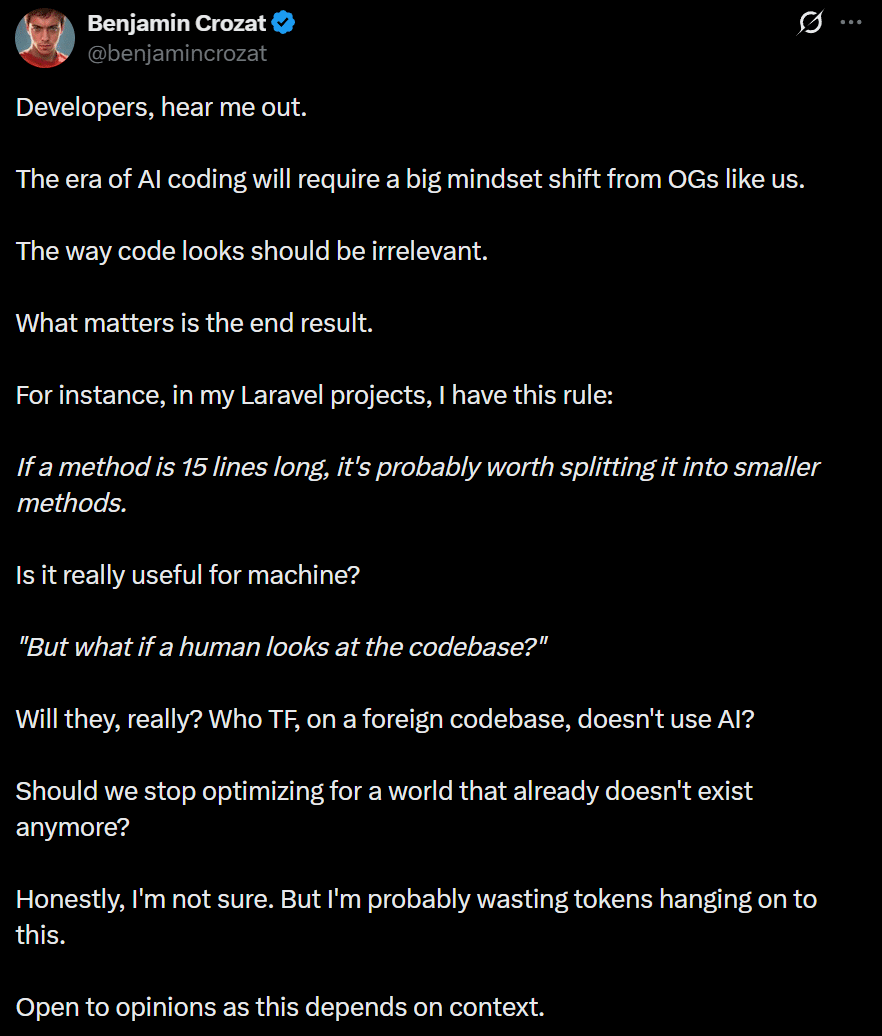
I stumbled upon a post that basically said the way the code looks should be irrelevant. What matters is the end result. On the surface, I get it. But I think it is naive.
When people talk about “how the code looks” they might be thinking structure, syntax, whatever. But to go beyond that, yes, it matters how it looks, because coupling still needs to be managed. Coupling is arguably the thing that when we are writing software we need to handle the most. If you want a long lived system that can evolve and change, you need to manage coupling.
If AI makes producing code cheap, guess what is also going to be cheap. Creating coupling. Creating a rat’s nest turd pile of coupling. What people call a big ball of mud. Something that is hard to change.
Everybody can relate to this. You make a change to one part of your system and it affects another part of the system unintentionally. Why does that happen? Coupling.
And you might be thinking, “But AI knows everything.” It does not.
“But it is going to know all the coupling.” Sure. But you already know all the coupling right now as well. And you still have this problem. So what is going to be different with AI?
If you are using a statically typed language, say in a monolith, you can find usages. You can run tools to know what your coupling is between different boundaries, or how your system runs. You can already know this, and you still end up with a turd pile that is brittle and hard to change.
So I do not think the answer in the era of AI is to ignore design. It is likely the opposite. It is providing a design that is built on constraints and context.
And that gets us to the real question. Where does that context live?
Where context actually lives
Context lives in the structure. It lives in the dependencies. It lives in the boundaries. And boundaries are still more important than ever because of coupling. All these foundational things you are doing now, even with AI in the mix, are still relevant.
So how do you capture the design and context in your system? First, you have to be explicit in the domain and the language you are using. I preach this so much. It is the opposite of CRUD, and the language now is more important than ever.
Use the context to understand what the domain is. Let me give you an example in logistics and shipping. What are the use cases? What are the things you do as part of the workflow?
You can dispatch an order. When a vehicle arrives at the shipper to pick up the freight, you arrive. When you pick up the freight, that is the load. When you leave and you are on route to delivery, that is depart. When you unload the freight or deliver it, that is empty.
These are explicit. It is the exact opposite of CRUD. CRUD provides no context. All the context is living in your end user’s head, because that is the workflow of how they interact with your system. If you have create shipment, update shipment, update stop… what is this? What does the system even do?
You would not be able to tell me what the workflow is, because the workflow is in somebody’s head. You are just recording current state. And if we are talking about current state and how you are recording state, it tells you how the system is now. But it gives you no context about how it got that way.
Events give you the story, not just the state
This is where events fit so naturally. There is a big difference between “shipment created” or “shipment updated.” What does that even mean? Versus being explicit about actions and commands.
An order was dispatched. It arrived. Loaded. Departed. Delivered.
These are explicit behaviors of your system. That language is the story of the domain. One of the most underrated places context lives is in language in the code. It tells you what the system does, and how it does it.
Not all language is created equal. You can be using terms, especially in a large system, that mean different things depending on the boundary. That is why boundaries matter. Boundaries preserve context and control coupling between them. The language inside that boundary encodes the intent of what it does. Events preserve intent by capturing what happened, and why.
Boundaries keep your concepts from being smashed together
When I talk about boundaries, I mean the different parts of the system that have their own context. In the logistics example, you might have sales, rating, orders, ordering. Visibility to customers about the status of their order. Execution, dispatch, tracking the vehicle and the path through delivery. Auditing. Communications with the customer. Billing and approvals, making sure documents are in place so you can invoice, pay carriers, pay drivers, whoever is executing the shipment.
Each one has its own context. And here is a really good example of what happens when you do not respect that. A system coupled everything so tightly to Stripe that it took a miniature Manhattan project to move off of it.
Using Stripe as a credit card processor is fine. But conflating Stripe payments with invoices is a mistake because they are not the same thing. Payments are money sent. Invoices are amounts owed for services and taxes and everything else. They are fundamentally separate concerns. Different concepts.
That is design. That is context.
AI can write code. It guesses your intent.
Design has always been important. But I am hoping now people see the value in capturing context within your design.
Create boundaries with specific context. Use the domain language explicitly. Make the concepts, the actions, the events, and the reasons why things happen, obvious in your code. Because CRUD only gets you so far. With CRUD, workflow and concepts are in the end user’s head. They are not in your system.
And if you are using AI to generate code, it does not have that workflow context unless you put it there. And of course, manage coupling between boundaries. Because AI producing code faster just means you can build a big ball of mud quicker if you are not managing coupling.
Join CodeOpinon!
Developer-level members of my Patreon or YouTube channel get access to a private Discord server to chat with other developers about Software Architecture and Design and access to source code for any working demo application I post on my blog or YouTube. Check out my Patreon or YouTube Membership for more info.